
Synlets vs OpenClaw: Managed AI Agents vs Self-Hosted Open Source
OpenClaw is the fastest-growing open-source AI agent ever. It's also a security nightmare for businesses. Here's how Synlets offers the same autonomous power with enterprise guardrails.
Synlets Team
Product
February 20, 2026
10 min read
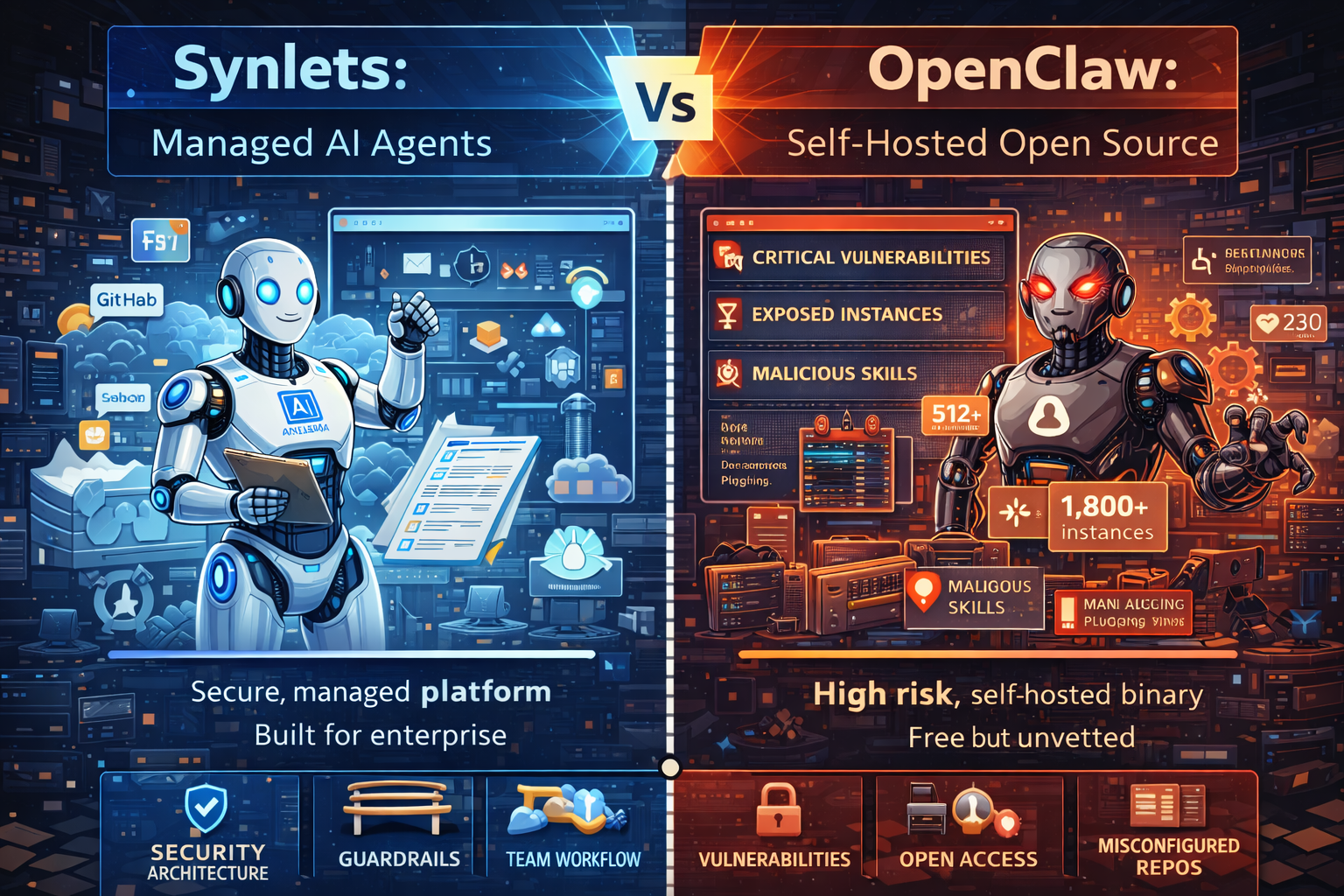
Synlets vs OpenClaw: Managed AI Agents vs Self-Hosted Open Source
OpenClaw is the biggest thing to happen to AI agents in 2026. Over 100,000 GitHub stars in under a week. Developers worldwide running autonomous AI agents on their machines — writing code, browsing the web, executing shell commands, managing repos.
It proved something important: people want AI agents that actually do things, not just chat.
But if you're a business — a startup with customer data, an enterprise with compliance requirements, or any company where "an AI ran shell commands on an employee's laptop" makes your security team nervous — OpenClaw has problems you can't patch away.
This post compares OpenClaw and Synlets: what each does, where each shines, and why businesses need a different approach to autonomous AI agents.
What is OpenClaw?
OpenClaw (formerly Clawdbot/Moltbot) is a free, open-source AI agent created by Peter Steinberger. It runs as a Node.js service on your machine and connects to LLMs to execute real-world tasks autonomously.
What makes it special:
- It has "eyes and hands" — it can browse the web, read/write files, and run shell commands
- It connects to messaging platforms (WhatsApp, Discord) as its interface
- It can automate debugging, DevOps, and codebase management with GitHub integration
- It supports scheduled cron jobs and webhook triggers
- It can even write its own skills to extend its capabilities
In short: OpenClaw is a general-purpose AI agent that lives on your computer and does whatever you tell it to. For individual developers and hobbyists, it's incredible.
The Security Problem
Here's where it breaks down for businesses. And this isn't speculation — these are documented findings from Cisco, CrowdStrike, Kaspersky, and independent security researchers:
512 Vulnerabilities Found
A security audit in late January 2026 identified 512 vulnerabilities, eight classified as critical. Researchers continued to disclose new vulnerabilities including critical authentication bypass bugs.
Malicious Skills in the Marketplace
In less than one week (January 27 to February 1), over 230 malicious plugins were published on ClawHub and GitHub. Once installed, they exfiltrated files, crypto wallets, browser passwords, macOS Keychain data, and cloud service credentials. The skills catalog had no adequate vetting or moderation.
1,800+ Exposed Instances
Security researchers scanning the internet found over 1,800 exposed OpenClaw instances leaking API keys, chat histories, and account credentials.
Prompt Injection — Unsolved
OpenClaw's own documentation admits: "Even with strong system prompts, prompt injection is not solved." Adversaries can embed instructions in data sources that OpenClaw ingests — emails, webpages, files — and hijack the agent's capabilities.
Root-Level Access
Because OpenClaw runs locally, users often give it terminal access, file system access, and in some cases root-level execution privileges. On a corporate machine connected to enterprise systems, a compromised OpenClaw instance becomes what CrowdStrike calls "a powerful AI backdoor agent."
This isn't a knock on the project. OpenClaw was designed as a personal AI assistant for individual use. It was never architected for enterprise deployment. But that hasn't stopped employees from installing it on corporate machines — and that's where the risk lives.
What is Synlets?
Synlets is a managed AI agent platform built specifically for software development teams and businesses. Instead of a general-purpose agent on your laptop, it's a purpose-built platform where AI agents handle the development cycle: ticket creation, code implementation, PR review, and iteration.
Key differences in architecture:
- Cloud-managed — No self-hosting, no local installation, no misconfiguration risk
- Scoped to software development — Agents do one thing well: turn tickets into working PRs
- Pull request workflow — Nothing touches your codebase without review and approval
- No persistent code storage — Repos are cloned at runtime, cleaned after each task
- Isolated execution — Each agent task runs in its own environment
- Audit trail — Every agent action is logged
Side-by-Side Comparison
| OpenClaw | Synlets | |
|---|---|---|
| Type | Open-source, self-hosted | Managed platform |
| Scope | General-purpose AI agent | Software development agents |
| Runs on | Your machine | Cloud infrastructure |
| Code access | Full filesystem + terminal | Scoped repo access via GitHub/GitLab |
| Security model | User-managed | Platform-managed with guardrails |
| Code storage | Local machine | None — cloned at runtime, cleaned after |
| Compliance | None built-in | Enterprise-grade |
| Vulnerability track record | 512+ found, ongoing disclosures | Purpose-built security architecture |
| Skill/plugin system | Open marketplace (moderation issues) | Closed, curated agent capabilities |
| Team use | Individual-focused | Multi-user with org management |
| Ticket integration | Via skills/plugins (DIY setup) | Built-in Jira, Asana, AI chat |
| Code review | Via skills/plugins (DIY setup) | Built-in AI review agents |
| Output | Anything (general-purpose) | Pull requests (purpose-built) |
| Pricing | Free (self-hosted + your API keys) | Free tier + pay-per-use (ACU credits) |
Where OpenClaw Wins
Let's be fair about what OpenClaw does better:
1. It's Free and Open Source
No subscription, no credits. You bring your own API key and run it on your hardware. For personal projects and learning, this is unbeatable.
2. General Purpose
OpenClaw isn't limited to software development. It can browse the web, manage files, send messages, control browsers, run DevOps tasks. Synlets is purpose-built for the software development cycle — that focus is a strength for teams, but a limitation if you want a general-purpose agent.
3. Extensible
The skills system lets you extend OpenClaw to do almost anything. It can even write its own skills. Synlets agents do what they're designed to do — implement tickets, review PRs, generate insights — but you can't teach them to order pizza.
4. Community
100,000+ GitHub stars. A massive ecosystem of tutorials, skills, and integrations. OpenClaw has the largest community of any AI agent project.
Where Synlets Wins
1. Security — By Architecture, Not Configuration
OpenClaw's security depends on how you configure it. Misconfigure it, and you have an exposed AI agent with root access to your machine.
Synlets' security is architectural:
- Agents can only access repos you've authorized
- All changes go through pull requests — nothing is deployed without approval
- Code is never stored — cloned at runtime, cleaned after
- Each task runs in isolation
- No shell access to your machines, ever
You don't need to "secure" Synlets because the security model is built into how it works.
2. Purpose-Built for the Development Cycle
OpenClaw is general-purpose — it can do software development tasks through skills and plugins, just like it can do almost anything else. You can configure it to interact with Jira, GitHub, review code, and more.
The difference is setup and focus. With OpenClaw, you're assembling the workflow yourself — finding the right skills, configuring integrations, managing how they work together. With Synlets, the entire development cycle works out of the box:
- Create tickets — AI chat that scans your codebase and generates well-defined tickets
- Implement code — Autonomous agents that read tickets and create PRs
- Review PRs — AI review agents that post human-like feedback and auto-fix issues
- Iterate on feedback — Leave comments, the agent reads them and pushes updates
- Generate insights — AI reports on project health, velocity, and patterns
It's the difference between a Swiss Army knife and a purpose-built tool. Both can cut — but one is designed specifically for the job.
3. Non-Technical Users Can Participate
OpenClaw requires technical setup — Node.js installation, API key configuration, command-line comfort. Its interface is messaging platforms or terminal.
Synlets is a web platform. A project manager creates a ticket in Jira, labels it, and gets a PR back. No installation. No terminal. No coding.
4. Team and Organization Support
OpenClaw is designed for individual use. There's no concept of organizations, team permissions, shared billing, or collaborative workflows.
Synlets has:
- Organization management with role-based access
- Shared billing across the team
- Project-level configuration (which repos, which models, which knowledge bases)
- Visibility into what every agent is doing across the org
5. No Maintenance Burden
With OpenClaw, you're responsible for:
- Installation and updates
- Security patches (15+ vulnerabilities disclosed in February alone)
- API key management
- Monitoring for exposed instances
- Ensuring employees aren't running misconfigured agents
With Synlets, you sign up and connect your repos. The platform handles everything else.
The Enterprise Reality
Here's the pattern we're seeing:
- A developer discovers OpenClaw, installs it on their laptop, and it's amazing
- They start using it for work — connecting it to company repos, running it against production code
- The security team finds out and has questions:
- "What data is this sending to external APIs?"
- "Who has access to the API keys it's using?"
- "Is it running with root privileges?"
- "What happens if a malicious skill gets installed?"
- "Are we compliant with our SOC 2 / HIPAA / PCI requirements?"
- The company either bans OpenClaw or scrambles to secure it (which, as security researchers note, is extremely difficult given its architecture)
Synlets exists for step 5: give the team the autonomous AI agents they want, with the security and controls the business requires.
Can You Use Both?
Yes, and some teams do:
- Developers use OpenClaw for personal productivity — quick scripts, research, local automation
- The team uses Synlets for production work — ticket implementation, PR review, code that touches the actual codebase
The key distinction: OpenClaw stays on personal machines for personal tasks. Production code goes through Synlets' managed, auditable pipeline.
The Bottom Line
OpenClaw proved that autonomous AI agents work. It showed the world what's possible when AI can actually do things, not just talk about them. That's genuinely important.
But "possible" and "safe for business use" are different things.
OpenClaw is the right choice if you're an individual developer who wants a powerful, free, general-purpose AI agent on your machine and you're comfortable managing the security implications.
Synlets is the right choice if you're a team or business that wants autonomous AI agents for software development with enterprise security, team collaboration, and zero self-hosting burden.
The vision is the same: AI agents that do real work. The difference is who's responsible when something goes wrong.
Keep reading:
- How AI Agents Handle Code Compliance — Automate compliance without the security risks
- What is an Autonomous AI Developer? — Definition and when to use one
- How to Enforce Coding Standards Across Distributed Teams — Enterprise-grade code quality
Synlets is a managed AI agent platform for software development. Generate tickets, assign to agents, get working PRs — with enterprise guardrails, not security nightmares.
More from the blog
Synlets vs Cursor: AI Agents That Ship PRs vs an AI Code Editor
Beyond Vibe Coding: When AI Should Work Without You
© 2026 Synlets. All rights reserved.