
How to Enforce Coding Standards Across Distributed Teams
When your engineers span multiple countries and time zones, maintaining consistent code quality becomes a coordination problem. Here's how AI solves it.
Synlets Team
Solutions
January 25, 2026
6 min read
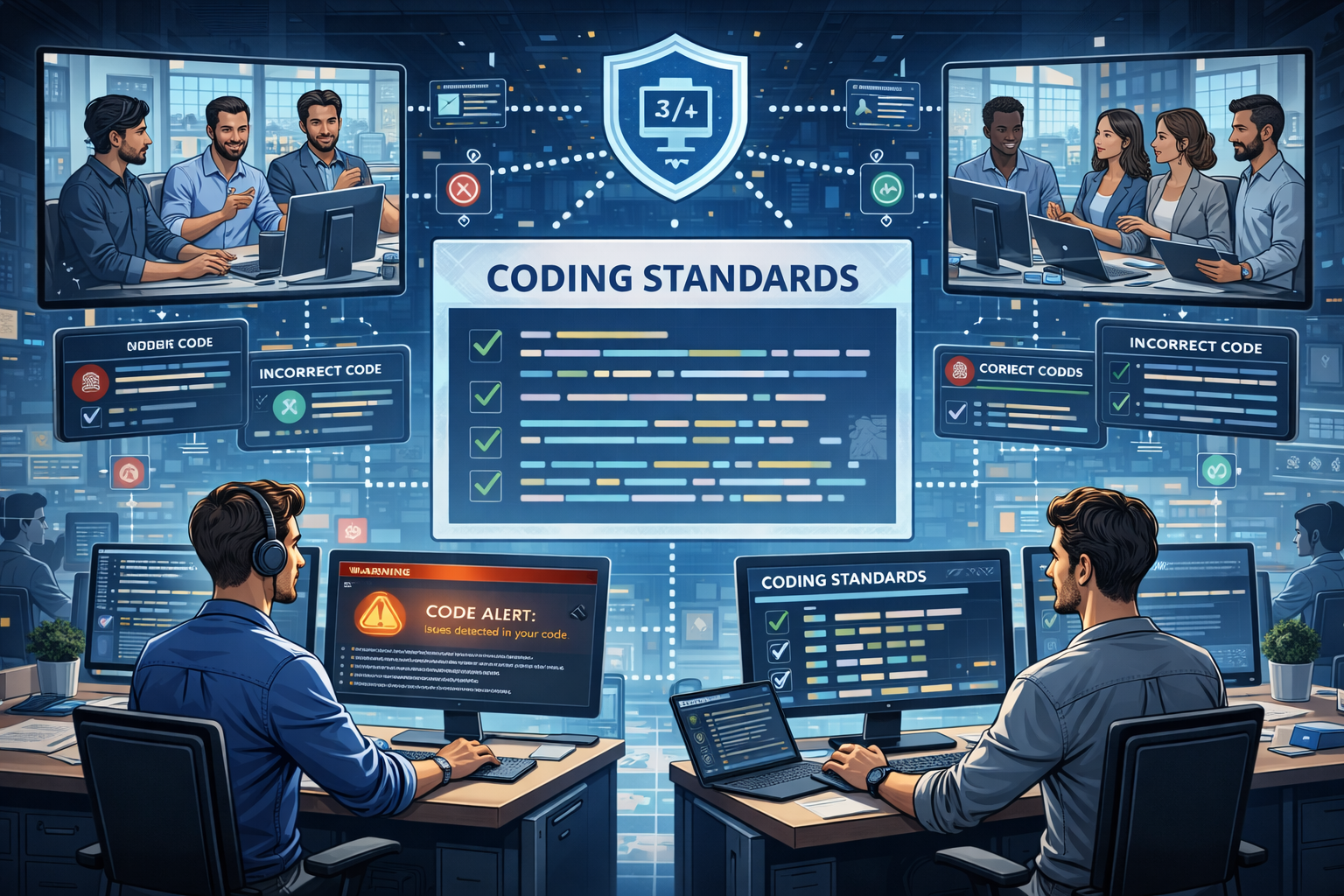
How to Enforce Coding Standards Across Distributed Teams
Your backend team is in London. Frontend is in Lisbon. A contractor in Manila handles mobile. They're all great engineers — but every PR looks different.
Naming conventions drift. Architectural patterns diverge. One team uses async/await, another uses callbacks. Your coding standards doc exists somewhere in Confluence, but nobody checks it before pushing code.
Sound familiar?
The Real Problem Isn't Skill — It's Coordination
Distributed teams don't write bad code because they're bad engineers. They write inconsistent code because:
- Different time zones — Your senior engineer in SF is asleep when the London team pushes PRs
- Different contexts — Each sub-team develops their own patterns in isolation
- Standards docs go stale — Written once, referenced never
- Review fatigue — Catching style issues in PRs is tedious, so people stop
The result: a codebase that looks like it was written by 15 different companies.
The Traditional Fix (And Why It Fails)
Most teams try:
- Linters and formatters — Good for syntax, useless for architecture
- PR templates — Filled out mindlessly
- Style guides — Written with good intentions, ignored within weeks
- Mandatory senior review — Creates bottlenecks, burns out your best people
These tools catch surface-level issues. None of them can tell you "this endpoint doesn't follow our API response format" or "we use the repository pattern here, not direct database calls."
How AI Review Agents Solve This
Configure a Synlets PR Review Agent with your actual standards — not just formatting rules, but architectural guidelines, design patterns, and compliance requirements.
What you upload:
- Your Confluence architecture docs
- Coding standards and conventions
- API design guidelines
- Security policies
- Any documentation you'd give a new hire
What the agent does:
Every PR, from every developer, in every time zone, gets reviewed against your standards automatically:
- Architectural consistency — "This service should use the repository pattern, not direct DB queries"
- API conventions — "Our endpoints return
{ data, meta, errors }, this one doesn't match" - Security standards — "This input isn't being validated before hitting the database"
- Naming conventions — "We use camelCase for variables, this file uses snake_case"
- Pattern enforcement — "Error handling in this module should use the ErrorBoundary pattern"
The Time Zone Advantage
Here's where it gets powerful for distributed teams:
6:00 PM GMT — London developer pushes a PR and goes home
6:01 PM GMT — AI Review Agent immediately reviews against your standards, finds two convention violations, and creates a child PR with the fixes against the developer's branch
6:15 PM GMT — Developer checks phone, sees the child PR, reviews the changes, and merges it into their branch — done
Next morning — Your SF team lead opens the PR. Standards are already enforced. They review architecture and logic, not style and patterns.
Nobody waited. Nobody was blocked. Nobody had to manually fix anything. Standards were maintained.
Compare this to the old way: PR sits for 12 hours until your senior engineer wakes up, leaves 8 comments about style issues, developer has context-switched to something else, back-and-forth takes 2 more days.
What AI Reviews Catch (That Linters Don't)
| Linter | AI Review Agent |
|---|---|
| Indentation wrong | Architecture pattern violated |
| Missing semicolon | API response format inconsistent |
| Unused variable | Security vulnerability introduced |
| Line too long | Design pattern not followed |
| Import order | Business logic in wrong layer |
Linters check syntax. AI review agents understand intent.
Setting It Up
- Upload your standards — Confluence pages, Notion docs, architecture decision records
- Enable PR Review Agent on your repositories
- Every PR gets reviewed — Automatically, instantly, consistently
The agent doesn't replace your human reviewers. It handles the standards enforcement so your senior engineers can focus on logic, architecture, and mentoring — the stuff that actually needs human judgment.
The Result
After enabling AI review agents, distributed teams typically see:
- Faster PR turnaround — No more waiting across time zones for basic feedback
- Consistent codebase — Same standards enforced regardless of who writes the code
- Happier senior engineers — Stop policing style, start mentoring
- Better onboarding — New developers get instant feedback on your conventions
Your coding standards don't fail because they're bad. They fail because enforcement is manual. Make it automatic.
Keep reading:
- Why Your Best Engineers Shouldn't Be Reviewing Routine PRs — Free up senior time for architecture, not style policing
- How AI Agents Handle Code Compliance — Automate GDPR, security, and migration updates
- Your First AI Hire — Adding an AI developer to your team
More from the blog
Synlets vs Cursor: AI Agents That Ship PRs vs an AI Code Editor
Synlets vs OpenClaw: Managed AI Agents vs Self-Hosted Open Source
© 2026 Synlets. All rights reserved.