
What is an Autonomous AI Developer?
A clear definition of autonomous AI developers, how they differ from coding assistants, and when to use them.
Synlets Team
Engineering
January 13, 2026
8 min read
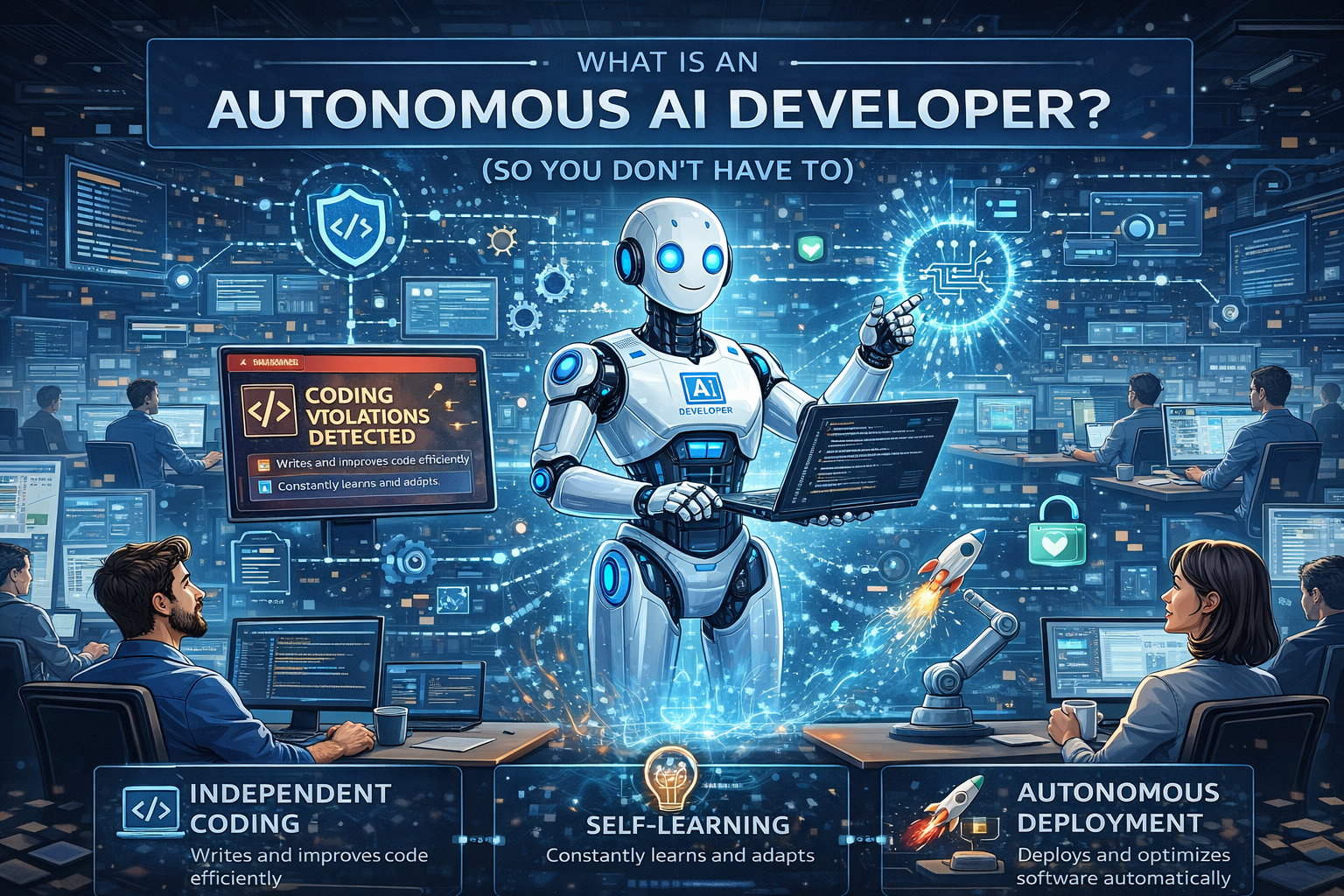
What is an Autonomous AI Developer?
An autonomous AI developer is an AI agent that independently completes software development tasks from start to finish — reading requirements, writing code, and delivering pull requests — without requiring human involvement during execution.
The Definition
Autonomous AI Developer (n.): An AI system that picks up development tasks from project management tools (Jira, Asana, Linear, etc.), implements solutions by writing code, creates pull requests, and responds to review feedback — all without human prompting or supervision during execution.
The key word is autonomous. Unlike AI coding assistants that wait for your input, autonomous AI developers work independently on assigned tasks.
How It's Different From...
Traditional Automation (CI/CD, Linters, Bots)
| Aspect | Traditional Automation | Autonomous AI Developer |
|---|---|---|
| Flexibility | Fixed rules | Understands context |
| Scope | Specific tasks | Any development work |
| Intelligence | Rule-based | Reasoning and adaptation |
| Setup | Heavy configuration | Learns your codebase |
Traditional automation follows scripts. Autonomous developers reason about problems.
Outsourced Development (Contractors, Agencies)
| Aspect | Outsourced Dev | Autonomous AI Developer |
|---|---|---|
| Communication | Meetings, async messages | Ticket description |
| Availability | Business hours, time zones | 24/7 |
| Onboarding | Weeks to months | Hours |
| Cost | $50-200/hour | ~$0.50-2 per task |
| Consistency | Varies by person | Consistent patterns |
Outsourcing requires coordination overhead. Autonomous developers read the ticket and work.
How Autonomous AI Developers Work
The Workflow
1. ASSIGN    →  Ticket appears in your task manager (Jira, Asana, GitHub Issues)
2. ANALYZE   →  AI reads ticket, explores codebase, understands context
3. IMPLEMENT →  AI writes code following your patterns and conventions
4. DELIVER   →  AI creates PR with description and test coverage
5. ITERATE   →  AI responds to review comments and updates PR
6. COMPLETE  →  Human approves and merges
What Happens During Execution
When you assign a task to an autonomous AI developer:
- Context gathering — Reads your codebase structure, documentation, and coding conventions
- Requirement analysis — Parses the ticket to understand acceptance criteria
- Solution design — Plans the implementation approach
- Code writing — Implements the solution across relevant files
- Self-review — Checks for obvious issues and edge cases
- PR creation — Commits changes and opens a pull request
- Feedback handling — If reviewers comment, addresses their concerns
All of this happens without you watching or prompting.
When to Use Autonomous AI Developers
Good Fit
- Bug fixes — Clear problem, defined solution
- Feature implementation — When requirements are specific
- Test coverage — Adding tests to existing code
- Refactoring — Improving code without changing behavior
- Migrations — Updating deprecated patterns codebase-wide
- Documentation — Syncing docs with code
Not Ideal
- Architecture decisions — Requires human judgment and tradeoffs
- Ambiguous requirements — "Make it better" doesn't work
- Novel research — Exploring unknown territory
- Cross-team coordination — Can't negotiate with other teams
- Performance optimization — Requires profiling and measurement
Why Now?
Autonomous AI developers weren't possible until recently because they require:
- Large context windows — Understanding entire codebases (200k+ tokens)
- Reliable reasoning — Planning multi-step implementations
- Tool use — Interacting with git, file systems, APIs
- Iteration ability — Responding to feedback coherently
These capabilities emerged in 2024 with models like Claude 3.5 and GPT-4. The technology finally caught up to the vision.
The Category is New
You won't find "autonomous AI developer" as an established software category yet. We're defining it.
The closest comparisons:
- DevOps automation — But for coding, not infrastructure
- Low-code platforms — But for real code, not visual builders
- Outsourced development — But instant, consistent, and cheap
In 2-3 years, every engineering team will have autonomous AI developers as standard. Early adopters are building the playbook now.
Getting Started
If you're evaluating autonomous AI developers:
- Start with clear tickets — AI works best with specific requirements
- Pick low-risk tasks — Build trust before mission-critical work
- Review like a teammate — Give feedback, the AI learns
- Measure impact — Track tickets completed, time saved, merge rate
The question isn't whether AI will write code. It's whether you'll be early or late to adopt it.
Keep reading:
- Beyond Vibe Coding: When AI Should Work Without You — Vibe coding vs agentic coding explained
- Why We Built AI Agents, Not Another Copilot — The autonomy spectrum from autocomplete to agents
- Synlets vs Devin — How Synlets compares to other autonomous AI developers
More from the blog
Synlets vs Cursor: AI Agents That Ship PRs vs an AI Code Editor
Synlets vs OpenClaw: Managed AI Agents vs Self-Hosted Open Source
© 2026 Synlets. All rights reserved.